How Company Culture Quietly Impacts Cybersecurity Risk
 Published on March 10, 2026
Updated on March 10, 2026
 4 mins to read
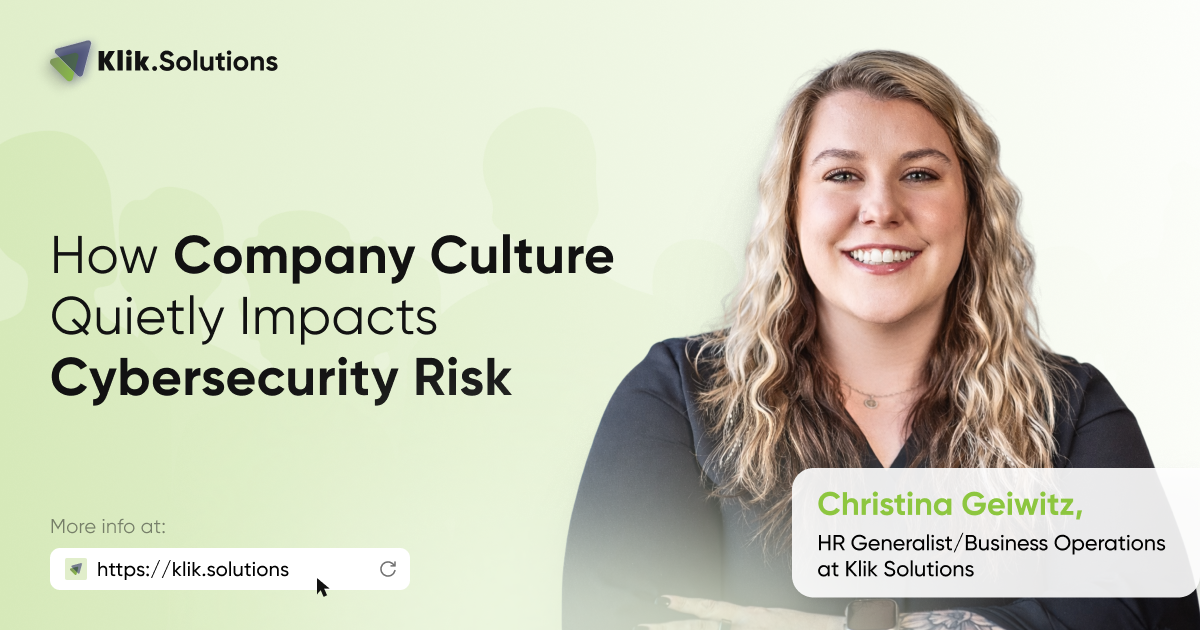
with Insights from Christina Geiwitz, HR Generalist/Business Operations at Klik Solutions
The company had invested wisely. Advanced endpoint protection. Multi-factor authentication. Cloud monitoring. A respected security partner. Annual training was completed on schedule. Cybersecurity policies and procedures were in place. Everything seemed to be set up to reduce risks.
Late one evening, an employee received an email that appeared to come from a senior executive requesting an urgent file. The request seemed reasonable. The tone matched the leader’s style. The employee wanted to be helpful and responsive. So, he sent the information.
The next morning, they discovered that the message had been spoofed. Luckily, they were able to contain the incident, but the damage was done and the risks were uncovered!
Situations like this are rarely the result of bad intentions. More often, they’re the result of normal human behavior, shaped by the culture in which people work.
In the aftermath, leadership realized something important.
Technology performed well.
However, a learning opportunity had been brought to light.
The Invisible Layer Beneath the Firewall
Cybersecurity conversations often begin with infrastructure — firewalls, detection tools, encryption, and zero trust architecture.
Those investments matter. They form the defensive perimeter. But inside that perimeter lives something equally influential: human behavior.
And human behavior is shaped by culture.
Christina Geiwitz, HR Generalist/Business Operations knows all too well about company culture. “Culture and cybersecurity are more connected than people realize. From an HR perspective, security isn’t just about systems — it’s about behaviors.”
She points out that it shows up in everyday moments: whether employees feel supported or rushed, whether they understand the “why” behind policies, and whether they feel safe speaking up when something doesn’t seem right.
Technology blocks threats, but the inherent culture influences how people respond to them. The strongest cybersecurity programs recognize that both layers play a significant role.

The Power of Signals
Every organization sends signals — intentionally or not.
- What gets praised?
- What gets measured?
- What gets questioned?
- What gets reinforced?
In fast-moving environments, agility and responsiveness are often celebrated. That energy fuels growth and innovation. At the same time, leaders who consciously reinforce secure decision-making alongside speed create balance.
Christina emphasizes that leadership plays a defining role here. “Leadership absolutely sets the tone. Teams pay attention to what leaders prioritize.”
When leaders model strong security habits and treat cybersecurity as a shared responsibility rather than an obstacle, it reinforces that it truly matters.
Security culture is not built through slogans. It’s built through consistency.
When thoughtful validation is valued as much as rapid delivery, pausing to verify a request doesn’t feel like friction. It feels like professionalism.
Creating Space for Early Reporting
One of the most powerful cultural indicators of cybersecurity maturity is how an organization handles mistakes.
In resilient environments, employees report suspicious activity quickly — not because they fear consequences, but because they understand transparency protects everyone.
Christina points out that psychological safety plays a critical role. “If employees know they won’t be blamed for raising a concern — or even admitting a mistake — they’re far more likely to speak up.”
That level of openness, she adds, is one of the strongest defenses any company can have. The faster concerns surface, the faster they can be addressed. Culture shortens response time. When leaders respond with curiosity instead of blame, small incidents become learning opportunities instead of escalating risks.

Making Security Part of How You Operate
Cybersecurity is often described as an IT responsibility. But in healthy organizations, it feels broader than that.
As Christina explains, “Cybersecurity feels like everyone’s responsibility when it’s woven into how we operate — in onboarding, in manager conversations, and in daily workflows — not just something owned by IT.”
This integration is subtle but powerful. When new hires are introduced to security expectations from day one, when managers reinforce secure practices in routine check-ins, and when workflows are designed with governance in mind, cybersecurity stops being an initiative and becomes a norm.
Ownership expands. Awareness deepens. Vigilance becomes distributed.
That distribution strengthens resilience far more than centralized control ever could.
The Executive Opportunity
For leaders, the opportunity isn’t to micromanage cybersecurity decisions. It’s to shape the environment in which those decisions are made.
Executives might ask:
- What behaviors are we reinforcing?
- Do employees understand the “why” behind our policies?
- Are we modeling the standards we expect?
- Is doing the secure thing clearly supported?
Christina offers a simple but powerful piece of advice. “Create a culture where doing the secure thing is the supported thing. When trust and accountability are strong, security follows naturally.”
This shift doesn’t require slowing innovation. It requires aligning incentives, communication, and leadership behavior with long-term resilience.
The Quiet Advantage
Every organization will face cybersecurity challenges. The digital landscape guarantees that.
The difference lies in how quickly risks surface, how transparently teams communicate, and how consistently leadership reinforces disciplined behavior.
Companies that intentionally shape their culture around accountability, clarity, and shared responsibility gain a quiet advantage. Their defenses extend beyond systems. They exist in habits, norms, and expectations.
Security becomes not just a technical function — but part of the company’s identity.
And when culture supports cybersecurity, resilience becomes sustainable!
BLOG