Nothing Broke… So Why Does Your Business Still Feel Slower?
 Published on April 10, 2026
Updated on April 10, 2026
 4 mins to read
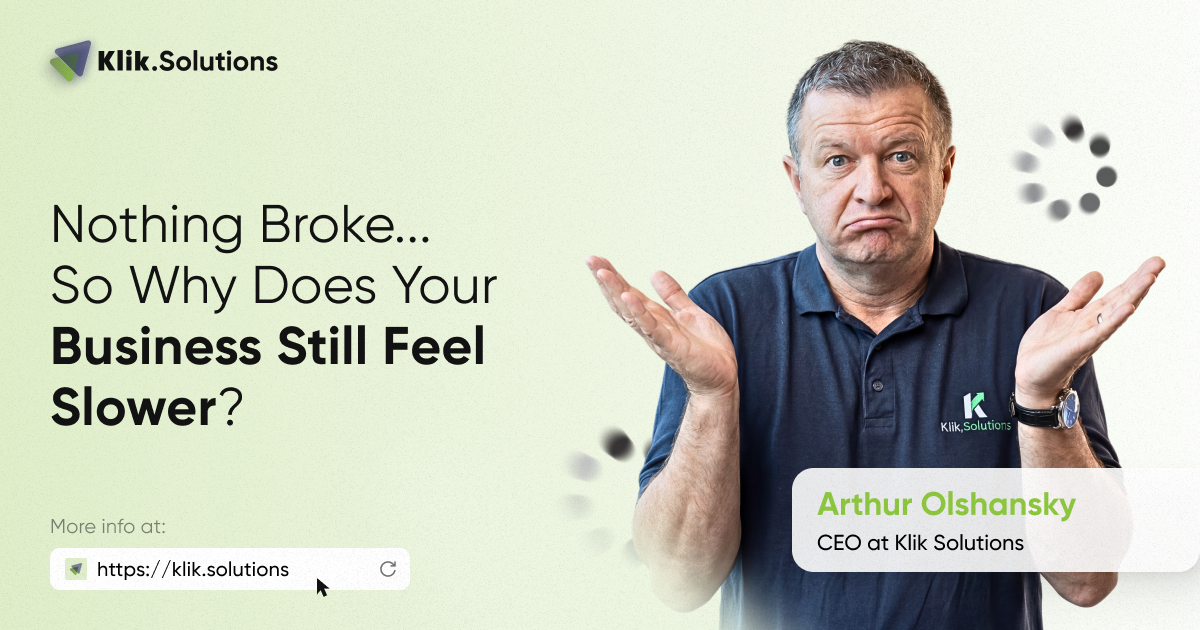
You log in. Your systems are technically working. There are no outages. No alarms. No red flags. And yet… everything feels heavier.
Pages take a second longer to load. Reports lag. Your team hesitates before clicking. Tasks that used to take minutes quietly stretch into hours.
Nothing broke. So why does it feel like your business is moving through mud? This is the kind of slowdown no one formally reports—but everyone feels.
The Problem Isn’t Failure. It’s Friction.
Here’s the uncomfortable truth: Most modern businesses aren’t slowed down by catastrophic failures. Instead, they’re slowed down by invisible inefficiencies that compound over time, such as:
- Tiny delays
- Disconnected systems
- Manual workarounds
- Data that exists—but doesn’t flow
Individually, these issues may seem harmless. Collectively, they create drag.
As Arthur Olshansky, CEO of Klik Solutions, puts it, “Technology should act as a growth enabler, not a bottleneck. When it doesn’t, something deeper is off.”
And in 2026, those deeper issues are showing up more often than many leaders expect.
1. Your Tools Work… But They Don’t Work Together
This is the most common culprit. Your CRM works. Your marketing platform works. Your reporting tools work. But do they talk to each other?
In many organizations, the answer is still no. That disconnect leads to duplicate data entry, reports stitched together across multiple systems, and decisions made on delayed or incomplete information.
This isn’t a technical failure. It’s an integration gap.
In an environment where speed depends on real-time visibility, disconnected tools quietly slow everything down without ever triggering an alert.
2. You’re Operating on Lagging Data
Businesses in 2026 aren’t short on data. They’re short on timely data. When insights arrive days or weeks too late, leaders are forced to react instead of lead.
Organizations that rely on weekly reports, static dashboards, or manual exports inevitably experience decision lag. High-performing teams are shifting toward real-time dashboards, predictive insights, and automated reporting pipelines. Without that shift, everything feels slower, because your decisions are.
As Arthur often notes, the widespread push toward data analytics and business intelligence is no accident. It’s foundational to speed and sustainable growth.

3. Manual Work Is Quietly Eating Your Time
Here’s a simple test. Ask yourself how many everyday tasks in your organization still require copying and pasting between systems, exporting spreadsheets, or re-entering the same data more than once.
If the answer is “too many,” you’ve found a major source of friction.
“Building analytics systems isn’t just about visibility,” Arthur explains. “It’s about eliminating manual processes that delay outcomes.”
Manual work doesn’t just cost time. It introduces errors, creates bottlenecks, and increases dependency on specific people. Over time, it builds an operation that can’t move faster, even when demand increases.
4. Your Infrastructure Hasn’t Kept Pace with Growth
This one often sneaks up on growing businesses. What worked when you had a small team, a single location, and modest customer demands doesn’t always scale to distributed teams, cloud-based environments, and higher service expectations.
Arthur points out that today’s businesses rely heavily on cloud environments, remote access, and layered security. Those layers are essential, but if they aren’t optimized, they introduce performance tradeoffs.
Growth adds complexity. If your infrastructure doesn’t evolve alongside it, your business will feel the strain—not as a crash, but as slowness.
5. Security and Compliance Are Adding Invisible Weight
Speed and security are constantly in tension. Modern organizations require multifactor authentication, endpoint protection, compliance monitoring, and stronger data governance. Each layer adds friction, particularly when implemented without usability in mind. The result is often a business that’s secure but inefficient.
The goal isn’t more security. It’s smarter, streamlined security that protects the organization without slowing work unnecessarily.

6. Your Processes Weren’t Built for Scale
“Well-defined, mature processes are a major driver of sustainable growth,” Arthur emphasizes. Without them, businesses rely on tribal knowledge, individual heroics, and a figure-it-out-as-you-go mentality that works, until it doesn’t.
When processes lack structure, tasks take longer, onboarding slows down, errors increase, and performance becomes inconsistent. Suddenly, everything feels harder than it should.
7. You’ve Outgrown “Good Enough” Technology
This is the realization many leaders resist. Nothing is technically broken. But “good enough” systems often don’t scale, integrate, automate, or provide the visibility modern organizations require.
In competitive environments, that gap shows up as slowness. Not because the business is failing, but because it’s outgrowing its current foundation.
So What’s Really Happening?
When a business feels slower, it’s rarely one big problem. More often, it’s a stack of small inefficiencies—outdated workflows, underutilized data, disconnected systems—that compound over time and quietly drain momentum.
What High-Performing Businesses Are Doing Differently in 2026
The fastest-moving organizations today aren’t working harder. They’re working cleaner. They integrate their technology stack end-to-end, automate repetitive processes, use real-time data to guide decisions, align security with usability, and build scalable, documented workflows.
Most importantly, they treat technology as a strategic growth engine rather than a support function. As Arthur advises, “We need to be using technology intentionally to help businesses grow and prosper—not just operate.”
Final Thought: Slow Isn’t Always Loud
Downtime is obvious. Inefficiency is quiet. It hides in extra clicks, delayed reports, manual steps, and daily frustrations—until one day your team is working just as hard but getting less done.
If your business feels slower, trust that signal. Nothing may be broken, but everything could work better.
And it’s worth a conversation.
Working with the right technology solutions partner can bring clarity to where friction is costing you momentum—and how to remove it. As Arthur Olshansky believes, even a short conversation can uncover opportunities to move faster, operate more efficiently, and scale with confidence.
Want to turn that insight into practical improvements that make day-to-day operations faster and easier? Reach out to our Klik Solutions Advisors and get a clear picture of where friction might be holding your business back—and what to do about it.