What CEOs Misunderstand About Compliance Structure
 Published on March 5, 2026
Updated on March 5, 2026
 5 mins to read
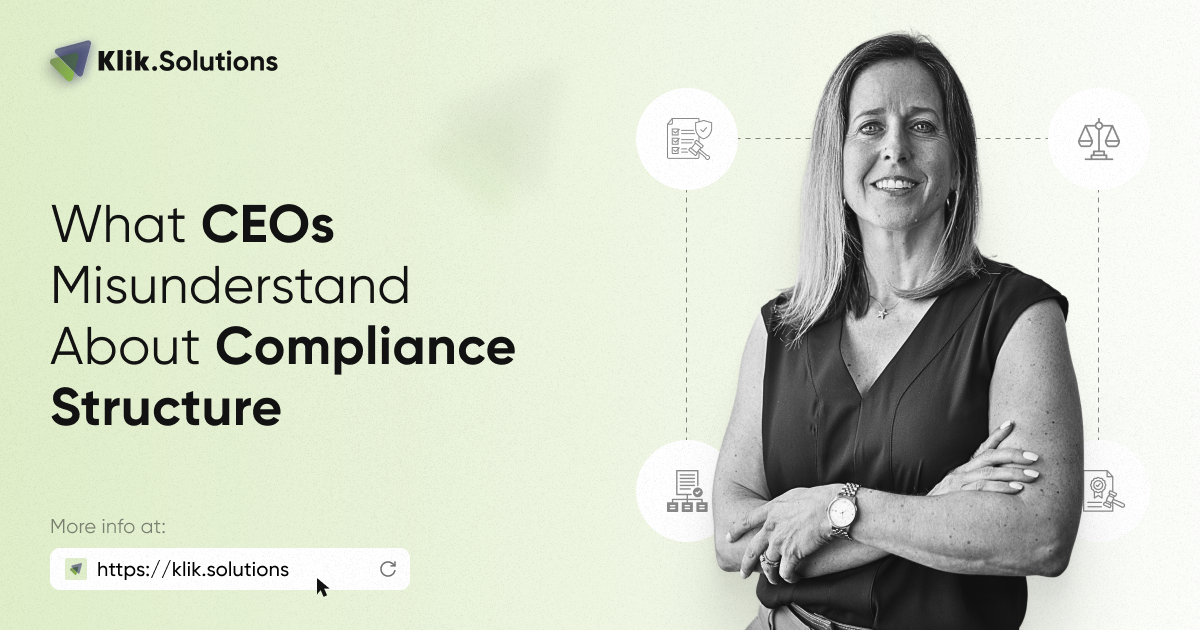
With Insights from Carin Weiss, Senior Solutions Advisor, Klik Solutions
Most CEOs don’t ignore compliance. In fact, many believe they’re doing everything right. They approve budgets for audits. They hire compliance officers. They pursue certifications. They review reports. On paper, it looks responsible and thorough.
And yet, companies with all those elements in place still experience regulatory penalties, failed enterprise deals, operational breakdowns, and preventable security incidents.
The issue usually isn’t effort. It is structure.
Misunderstanding #1: Compliance Is a Department, Not a System
Many executives misunderstand what compliance is. They see it as paperwork, oversight, or a regulatory obligation. But compliance isn’t a stack of policies or a successful audit outcome. It’s the operational architecture that determines how risk is managed every single day.
One of the most common misconceptions is treating compliance as a department rather than a system. It’s often assigned to Legal, IT, or Risk, as if ownership can be neatly contained.
Compliance touches everything — how you build products, manage data, select vendors, onboard employees, and enforce financial controls. When teams treat compliance as a departmental responsibility, blind spots multiply. Legal drafts policies. IT implements controls.
The operations department pushes for speed. Sales pushes for flexibility. And in the friction between those priorities, risk takes root.
Strong organizations don’t isolate compliance. They embed it. It becomes part of workflows, approvals, automation, and decision-making. It is not a separate checklist running parallel to the business.
Carin Mikhail, Senior Solutions Advisor at Klik Solutions, often explains to the leadership teams she works with, “Policies often fail to translate.”
Written documentation may exist, but unless we embed it into operational behavior, it does little to reduce risk.

Misunderstanding #2: Policies Equal Protection
Another misunderstanding is the belief that having policies provides equal protection. A beautifully written policy manual can create a false sense of security.
But policies do not protect organizations. The behavior of the people within the organization does. If teams routinely bypass controls to hit deadlines, if shared credentials become common practice, if they skip approval processes in the name of urgency, for example, then the documented controls don’t reflect the operational reality.
The real question isn’t whether a policy exists. It’s whether daily behavior aligns with it.
Compliance that works is operationalized. Automated controls are in place where possible. Continuous monitoring is the norm. Accountability is defined. Documentation supports the structure — it doesn’t substitute for it.
That disconnect between documentation and real-world behavior is something Carin frequently encounters when organizations begin evaluating their compliance readiness.
“These compliance programs are overwhelming. It is significant,” she explains. “It’s not a little switch we just switch on.”
Compliance maturity requires sustained operational discipline, not a quick implementation.
Misunderstanding #3: Compliance Is a Cost Center
There’s also a persistent tendency to view compliance as a cost center. From this perspective, compliance is something to minimize. It’s just a necessary expense requiredto satisfy regulators or close enterprise deals.
Carin often sees this hesitation early in conversations with leadership teams.
“Primarily resistance to cost… folks are determined to do it in-house because they are risk-averse to how much it’s going to be costing them,” she explains.
But that perspective misses the broader financial reality. “We want to talk about cost? Let’s look at it. What’s the cost of NOT doing this?”
Mature organizations understand something different. Properly structured compliance reduces regulatory exposure, lowers cybersecurity risk, strengthens investor confidence, and unlocks growth opportunities.
Enterprise customers increasingly demand proof of operational maturity. Investors evaluate governance discipline. Global expansion requires regulatory readiness.
Compliance doesn’t just reduce risk. It protects revenue and creates opportunity. With executives evaluating compliance initiatives, Carin frames it this way. “What opportunities would be lost by not pursuing this?”
When done appropriately, compliance stabilizes the business rather than slowing it down. It creates a foundation that allows the company to scale with confidence.

Misunderstanding #4: Compliance Is Static
Perhaps the most subtle misunderstanding is treating compliance as static. A milestone. A badge.
“We achieved SOC 2.”
“We’re ISO certified.”
“We’re compliant with GDPR.”
But regulations continue to evolve. Technology stacks evolve. AI adoption introduces new risks. Vendor ecosystems expand. Remote work reshapes data exposure. Change is inevitable and frequent.
Compliance cannot be a one-time achievement because the risk landscape is never frozen. It must be continuously assessed, refined, and integrated into your strategic planning.
Organizations also frequently overestimate how prepared they are to begin formal compliance programs. Carin recalls a conversation with one executive who believed his business environment was ready for audit.
“I told him, if you get audited today, you’re shut down.”
The issue wasn’t negligence — it was misplaced confidence.
“There’s so many things that could be violations and I know you’re a good company… but let’s do this in a structured approach,” she explains.
Before frameworks like SOC 2, CMMC, or ISO can be pursued successfully, organizations must first stabilize their operational foundations.
“They might have an aspiration of becoming CMMC or SOC 2… but understanding where they’re at is key.”
The Real Issue: CEOs Confuse Compliance with Certification
This is where many CEOs confuse certification with maturity. Of course, certifications matter. They signal credibility and preparedness. However, passing an audit proves documentation at a moment in time. It does not prove operational resilience OVER time. There is a difference between preparing for an audit and designing an organization that sustains disciplined controls year-round.
Audit culture mobilizes resources temporarily. Compliance culture embeds discipline permanently.
What Strong Compliance Structure Actually Looks Like
When the compliance structure is strong, you see it clearly. Not because it’s loud, but because it’s consistent.
Executive leadership has meaningful visibility into risk metrics, not just high-level summaries during audit season. They must clearly define accountability and distribute itacross departments, so compliance isn’t concentrated in one team but reinforced across the organization. Controls embedded directly into systems and workflows reducereliance on manual enforcement or individual memory. Monitoring happens continuously, allowing issues to surface early rather than during annual reviews.
Building that level of maturity requires deliberate progress.
As Carin describes organizations beginning to strengthen their environments, “We’re going to have quite a bit of work cleaning up and just structuring their environment to stabilize it… taking a phased approach.”
“Sometimes the first steps are foundational. Let’s just clean things up… now we have regular patches. You actually have an antivirus. Awesome.”
Those operational improvements form the groundwork that makes future certifications achievable.
She often reminds leadership teams that clients need to be met where they are.

The Business Consequences of Getting It Wrong
When compliance structure is weak, the consequences don’t usually appear all at once. They surface gradually — in inconsistent controls, unclear accountability, and gaps that go unnoticed until they’re exposed under pressure.
The greater impact shows up in lost enterprise deals when procurement teams question governance maturity, in stalled acquisitions during due diligence, and in investor hesitation when structural gaps surface. Structural weaknesses tend to emerge at the worst possible moment — during audits, acquisitions, security incidents, or public scrutiny.
There’s also an internal cost. Without a clear compliance architecture, teams operate with ambiguity. Decision-making slows, accountability blurs, and risk management becomes reactive instead of intentional.
Ultimately, compliance is not about avoiding fines. It’s about building a company that can withstand scrutiny, earn trust, and scale responsibly — ensuring growth supported by governance, not undermined by it.
The CEO Shift: From Oversight to Architecture
Structure does not emerge accidentally. It reflects executive priorities. The CEO’s role is not to manage every control but to ensure the architecture exists. To ask not just “Did we pass?” but “How does compliance live in our operations?” Not just “Who owns it?” but “How is it integrated?”
Compliance Is a Leadership Issue
Compliance maturity reflects leadership maturity. Because structure, more than policy, determines resilience.
The organizations that endure don’t treat compliance as cleanup. They treat it as design. And design determines durability and longevity.
BLOG