What Clients Usually Realize After the First IT Review
 Published on March 18, 2026
Updated on March 18, 2026
 5 mins to read
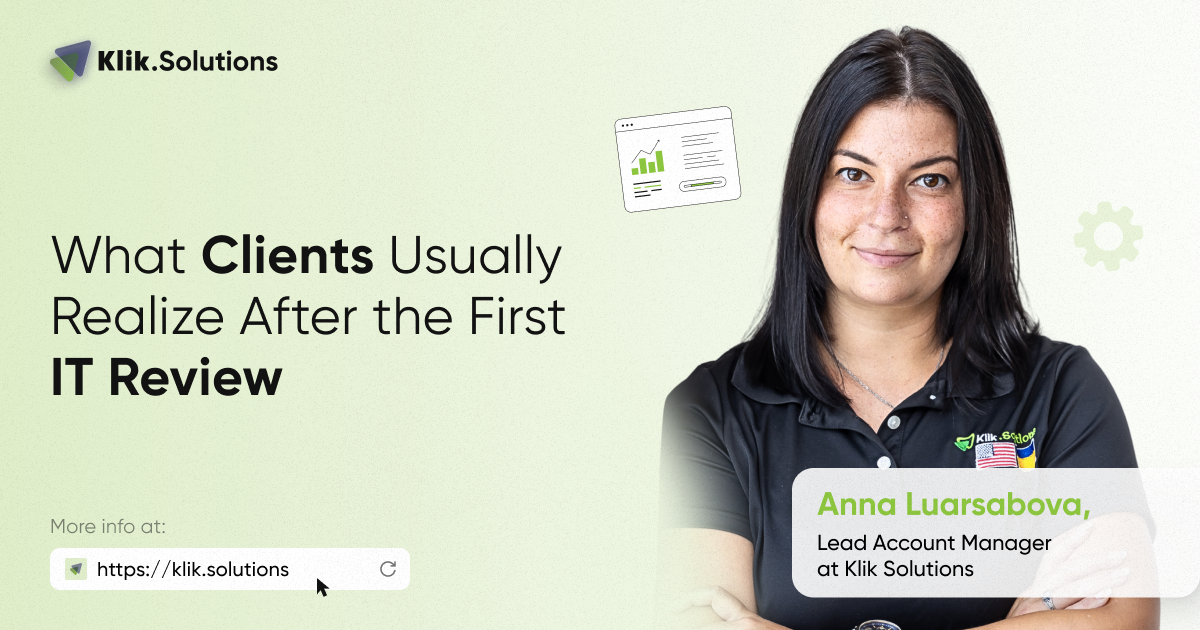
With insights from Anna Luarsabova, Lead Project Manager
For many businesses, the first Technical Business Review (TBR) feels like stepping into the unknown.
Some teams walk in feeling confident.
Others carry a quiet sense of concern about what might surface.
And some take a more optimistic view, with a “never a problem, only an opportunity” approach.
We’ve seen all these reactions.
But one thing we often share before the conversation begins is simple:
Be ready for anything and surprised by nothing.
Because a TBR rarely starts the way people expect.
There’s no emergency.
No system failure.
No urgent outage forcing action.
Most of the time, the meeting begins quietly.
A few dashboards appear on the screen.
Someone walks through recent tickets.
Security gets a quick mention.
Backups come up briefly.
At first, it feels like a routine check-in. But somewhere in the middle of the conversation, something shifts. A pattern becomes visible, and that’s usually the moment when teams realize something important.
The client’s IT environment tells a much clearer story than they expected.
What Does a Technical Business Review Actually Show?
A Technical Business Review isn’t just a summary of recent IT activity. It’s a structured look at the entire environment. Not one system. Not one issue. The whole picture.
This includes things like:
- infrastructure and lifecycle planning
- security controls
- backup and disaster recovery
- policies and governance
- long-term IT strategy
When it is all viewed together, it becomes easier to understand not just what is happening, but also why certain issues keep repeating.
Our Lead Account Manager, Anna Luarsabova, puts it this way. “A lot of teams are used to solving things as they come up. The review is usually the first time everything is connected in one place.”
That connection is where clarity starts.

When “Everything Seems Fine” — But Isn’t Fully Visible
In one recent review, nothing appeared broken at first glance.
Systems were running.
Users were working.
No major incidents had been reported.
From the outside, things looked stable, but as the assessment went deeper, a different picture started to form. Multi-factor authentication wasn’t in place. Backups were only stored locally. Security monitoring wasn’tcentralized. There was no structured password management. Employees hadn’t received formal phishing awareness training.
Individually, none of these gaps had caused a visible issue yet, but together, they created a level of exposure that hadn’t been fully recognized.
Anna described this moment well. “It’s rarely one big problem. It’s usually several smaller things that haven’t been looked at together before. That’s often the turning point in a TBR.”
Not panic — just awareness.
Why Hidden Risks Stay Hidden
One of the reasons these gaps go unnoticed is simple. Most IT environments evolve over time. New tools are added. Teams grow. Priorities shift.
Along the way, certain areas don’t get revisited. Backup strategies stay the same. Policies exist but aren’t updated. Security tools are installed but not fully configured. Day-to-day operations continue without interruption, so nothing feels urgent, but risk doesn’t always announce itself. It builds quietly.
A Technical Business Review brings those quiet risks into view — before they turn into something disruptive.
What Changes When Everything Is Organized Clearly
One of the most useful parts of a TBR is how it organizes complexity.
Instead of presenting an extensive list of technical findings, everything is structured into clear categories:
- What is at risk?
- What needs attention?
- What is an acceptable risk?
- What is already aligned?
This allows leadership to quickly understand priorities without needing deep technical knowledge.

In the example above, several areas were identified as high risk:
- backup strategy
- security monitoring
- password management
- lifecycle planning
- security policies
- phishing training
Not because anything had failed — but because the foundation needed to be strengthened.
As Anna explained, “Once we categorized everything, the conversation changed. It’s no longer, “What’s wrong?” It becomes, “What should we focus on first?”
That shift makes decision-making much easier.
How Technical Details Start Connecting to Business Impact
Another moment that often stands out during a first review is when technical gaps are translated into real-world consequences.
Not in a dramatic way — just clearly.
For example, a local-only backup strategy doesn’t feel urgent until you consider what happens during ransomware. A lack of lifecycle planning doesn’t seem critical until aging infrastructure begins to affect reliability and cost. Missing patches may not cause immediate issues, but they leave systems exposed to known vulnerabilities.
When these connections are explained simply, IT discussions start aligning with business priorities, and that’s where the value of the review becomes much more tangible.
Moving From Reactive Work to Structured Planning
Before structured reviews are introduced, many organizations operate in a reactive mode.
Issues are addressed as they appear.
Updates are handled when time allows.
Planning happens in short cycles.
In the case above, there was:
- no formal lifecycle planning
- limited documentation
- no structured IT roadmap
- no consistent approach to long-term improvements
Again, nothing unusual. Just a system that had grown over time without a clear framework.
A Technical Business Review introduces that structure. It creates space to think about:
- security improvements over time
- budgeting and prioritization
- future infrastructure needs
- risk management
Anna reminds us, “The goal isn’t to overwhelm anyone. It’s to make things feel more predictable.”
And predictability is often what teams are really looking for.

What Progress Looks Like Over Time
One review brings clarity, but the real value appears over time. In this case, the initial assessment identified several high-risk areas.
A plan was created.
Improvements were prioritized.
Changes were implemented gradually.
Nothing rushed. Nothing forced.
Over time, the environment became more structured, more secure, and easier to manage.
Today, that same organization is fully aligned with recommended standards.
Not because everything changed overnight, but because each step built on the previous one.
That’s how Technical Business Reviews are meant to work. Not as a one-time evaluation — but as an ongoing process of alignment.
Why Governance and Policies Often Come into Focus
Another area that often surfaces during the first TBR is governance. Many organizations operate without fully defined or updated policies.
In this case, several were either missing or unclear:
- password policies
- encryption standards
- removable media guidelines
- BYOD policies
- business continuity planning
These gaps don’t usually affect daily operations, but they do affect long-term resilience, compliance, and data protection. A review helps bring these elements into the conversation — in a way that feels manageable, not overwhelming.

Creating Transparency That Builds Trust
One of the less obvious outcomes of a Technical Business Review is transparency. Both the client organization and the technology solutions partner begin working from the same understanding:
- Where risks exist.
- What priorities matter most.
- What the long-term direction looks like.
This shared visibility changes the relationship. Instead of reacting to issues, teams start planning together. As Anna shared, “When everyone sees the same picture, conversations become much easier. There’s less guesswork.”
And less guesswork leads to better decisions.
A Simple Conversation That Brings Clarity
The first Technical Business Review rarely feels dramatic. Most teams leave the meeting with a similar realization, a better understanding of the current reality.
Nothing urgent happened. Nothing broke, but things became clearer.
Patterns made more sense. Priorities felt more defined. Decisions felt easier.
Sometimes, that’s exactly what a growing organization needs. Not more tools. Not more complexity. Just a structured way to understand what is already there.
Ready to Experience a TBR Like This?
Sometimes, the most valuable insights come from simply stepping back and looking at your environment with a structured perspective.
If you’d like to walk through your systems, risks, and opportunities clearly and practically, reach out to the Klik Solutions team. We’re always happy to start the conversation.