The Hidden Cost of Ignoring Tech Debt in 2026: A CIO’s Perspective
 Published on January 13, 2026
Updated on February 26, 2026
 6 mins to read

In the world of finance, debt is a well-understood tool. When used strategically, it accelerates growth. When ignored, it leads to insolvency. In 2026, technology operates under the exact same laws of physics. Viewing tech debt as a mere inconvenience for the engineering team is a failure of leadership.
In the current landscape, tech debt is a compounding business liability that directly impacts your revenue, your compliance posture, your cybersecurity resilience, and your ability to innovate. Ignoring tech debt in 2026 isn’t just a technical oversight; it’s a strategic choice to let your company’s engine rust while your competitors move to electric.
What Tech Debt Really Means in 2026 (Beyond Outdated Code)
Historically, tech debt was defined as the cost of choosing an easy, “quick-and-dirty” solution now instead of a better approach that would take longer. In 2026, the definition has expanded. It is no longer just about poorly written code or “spaghetti” scripts. Today, tech debt is the gap between what your technology can do and what your business requires it to do. It manifests in three primary layers:
- Infrastructure Debt: Legacy servers, unoptimized cloud configurations, and “zombie” resources that haven’t been decommissioned.
- Security Debt: Unpatched vulnerabilities, outdated encryption protocols, and “identity sprawl” where permissions have been granted but never revoked.
- Process Debt: Manual workflows that should be automated, siloed data that prevents AI integration, and a lack of standardized documentation.
The Compounding Interest: Financial Impact and Opportunity Cost
The reason we call it “debt” is because of the interest. In IT, interest isn’t paid in dollars to a bank; it’s paid in maintenance hours and lost opportunity.
Every hour your team spends “keeping the lights on” for a legacy system is an hour they aren’t spending on high-value innovation. The financial impact can be expressed through a simple conceptual framework:
Total IT Cost = Maintenance + Opportunity + Risk
Where:
- Maintenance is the rising cost of supporting aging systems.
- Opportunity is the revenue lost because you couldn’t launch a new feature or product in time.
- Risk is the potential cost of a breach or compliance failure associated with that debt.
In 2026, many organizations will find that their maintenance is consuming upwards of 70-80% of their total IT budget. This leaves only a fraction of resources for growth. Smart companies realize that paying down the principal (modernizing) is the only way to lower the interest and reclaim their budget for innovation.

Security Risks: The Invisible Target on Legacy Systems
If you asked a CISO what keeps them up at night in 2026, it’s rarely the “zero-day” exploit on a new system. It’s the “known” vulnerability sitting in a legacy application that was built a decade ago and can’t be patched without breaking the entire workflow.
The “Security Debt” Cycle
Legacy systems often rely on outdated libraries or protocols (like TLS 1.0 or 1.1) that are no longer secure. When you leave these systems in place, you are essentially leaving a side door unlocked. Cybercriminals in 2026 use AI-driven scanners to find these weak points in seconds.
Furthermore, insurance providers have caught on. In 2026, cyber insurance premiums are directly tied to your “technical hygiene.” If you are running unsupported software, your premiums skyrocket—or worse, your coverage is denied entirely following a breach.
Compliance Exposure: SOC 2, HIPAA, and Beyond
Compliance in 2026 is no longer a “once-a-year” event; it is a state of continuous assurance. Tech debt is the primary enemy of this state.
Whether it’s SOC 2, HIPAA, or GDPR, modern regulations require deep visibility into where data is stored and who can access it. Legacy systems are notoriously “opaque.” They often lack the logging capabilities, granular access controls, and audit trails required by modern auditors.
If your data is trapped in an old SQL database that doesn’t support modern encryption-at-rest or multi-factor authentication, you aren’t just dealing with tech debt—you are dealing with a looming legal and financial disaster.

The Innovation Roadblock: AI, Automation, and Scalability
You cannot build a skyscraper on a foundation of sand. In 2026, the skyscraper is artificial intelligence (AI).
Every company wants to leverage AI to automate customer service, predict supply chain disruptions, or personalize marketing. However, AI requires clean, structured, and accessible data. Tech debt often looks like “Data Silos”—legacy systems that don’t talk to each other, using inconsistent formats and no APIs.
If your data is locked in a 15-year-old ERP system that doesn’t support real-time data streaming, your AI strategy is dead on arrival. You end up spending more on “data cleaning” and “middleware” than on the AI itself. This is the ultimate “hidden cost” of tech debt: it makes the future impossible.
Productivity Loss: The Human Cost of Legacy Systems
One of the most overlooked costs of tech debt is the impact on your talent. Top-tier IT professionals in 2026 do not want to work on “museum pieces.” When you force your best engineers to spend their days troubleshooting 20-year-old code or managing manual server migrations, two things happen:
- Productivity Drops: Tasks that should take minutes take hours because of the complexity and fragility of the systems.
- Attrition Rises: Your best people leave for companies that are working on modern, cloud-native stacks. You are then left with a team that only knows how to maintain the old systems, further entrenching your debt.
Why “Fix it Later” is a Dangerous Myth
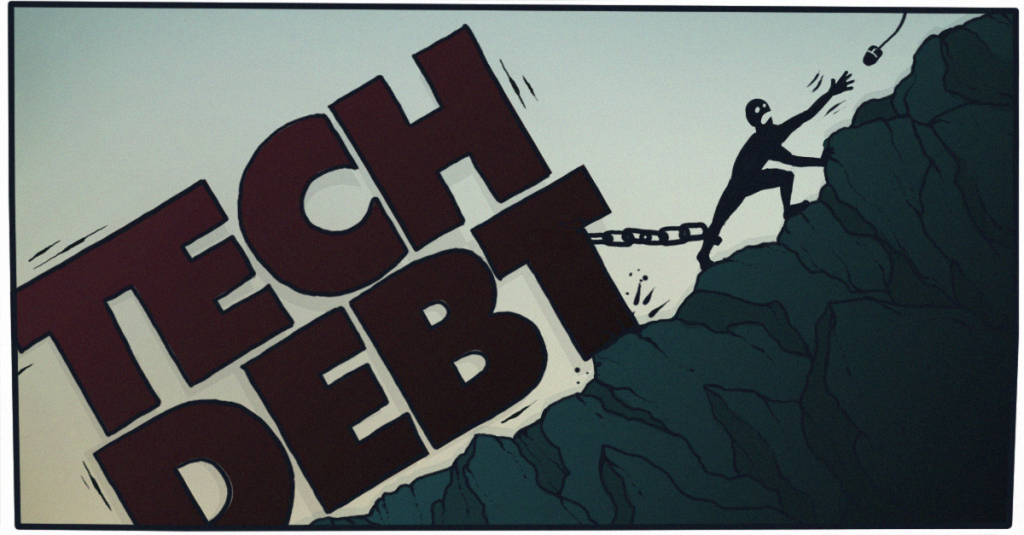
The phrase “we’ll fix it later” assumes that the cost of fixing it remains constant. It doesn’t. Tech debt is exponential, not linear.
As a system ages, the people who built it leave. The documentation becomes outdated. The hardware it runs on becomes harder to source. The third-party libraries it depends on are no longer maintained. What would have cost $50,000 to modernize three years ago might cost $500,000 today because it has become deeply entwined with other business-critical processes.
CIO-Level Warning Signs: Is Your Tech Debt Becoming a Business Threat?
As a professional, you need to recognize when tech debt has moved from “managed” to “critical.” Look for these red flags:
- The “Fear of the Update”: Your team is afraid to update or patch a system because they are worried the whole thing will collapse.
- The “Shadow IT” Explosion: Employees are bypassing the official IT systems and using their own SaaS tools because the company systems are too slow or difficult to use.
- The “Integration Wall”: It takes months to integrate a simple new tool into your existing infrastructure.
- The “Hero Culture”: You rely on one or two “legacy heroes”—people who are the only ones who know how the old system works. If they retire, you are in trouble.
Strategic vs. Reactive: How to Manage and Prevent Future Debt
You will never have zero tech debt. The goal is tech equity. This means managing your debt so it doesn’t hinder your growth.
- Conduct a Tech Debt Audit: Stop guessing. Use a partner to map out your infrastructure, identify legacy risks, and quantify the cost of inaction.
- Establish a Modernization Roadmap: You can’t fix everything at once. Prioritize the debt that carries the highest security risk or provides the biggest roadblock to AI/Automation.
- Adopt “FinOps” and “SecOps”: Integrate financial and security accountability into your IT workflows to prevent new debt from accumulating silently.
- Partner for Leverage: Many organizations don’t have the internal bandwidth to pay down tech debt while also running daily operations. Modern IT partners (like Klik Solutions) provide the specialized talent and frameworks to modernize your stack without disrupting your business.
Your Next Step: From Liability to Leverage
Tech debt isn’t just a line item in a budget; it’s a ceiling on your company’s potential. In 2026, the companies that thrive will be those that have the courage to stop “patching” the past and start building the future.
Don’t wait for a system failure to force your hand. Assess your current tech debt exposure and create a realistic modernization roadmap before it becomes a business-critical risk.
FAQ
What is tech debt and why does it matter in 2026?
Tech debt is the cumulative cost of choosing shortcuts or maintaining outdated systems. In 2026, it matters because it directly blocks AI adoption, increases security risks, and drains budgets that should be used for innovation.
How does technical debt affect cybersecurity?
Legacy systems often cannot be patched against modern threats, lack Multi-Factor Authentication (MFA), and use outdated encryption. This creates “soft spots” in your perimeter that are easily exploited.
Can tech debt impact compliance and audits?
Yes. Modern regulations require transparency and data protection that legacy systems simply weren’t built to provide. Failing to modernize can lead to failed audits and heavy fines.
How do CIOs measure the cost of tech debt?
We look at the ratio of “Run” (maintenance) vs. “Grow/Innovate” (new projects) spend, ticket volume related to legacy systems, and the time-to-market for new features.
Is tech debt always bad, or sometimes acceptable?
Short-term tech debt is acceptable to meet a critical deadline. However, it must be “intentional” debt with a clear plan to pay it back. Unintentional, ignored debt is what becomes dangerous.