What’s Next in Cloud? 2026 Predictions for Business Leaders
 Published on December 16, 2025
Updated on February 26, 2026
 7 mins to read
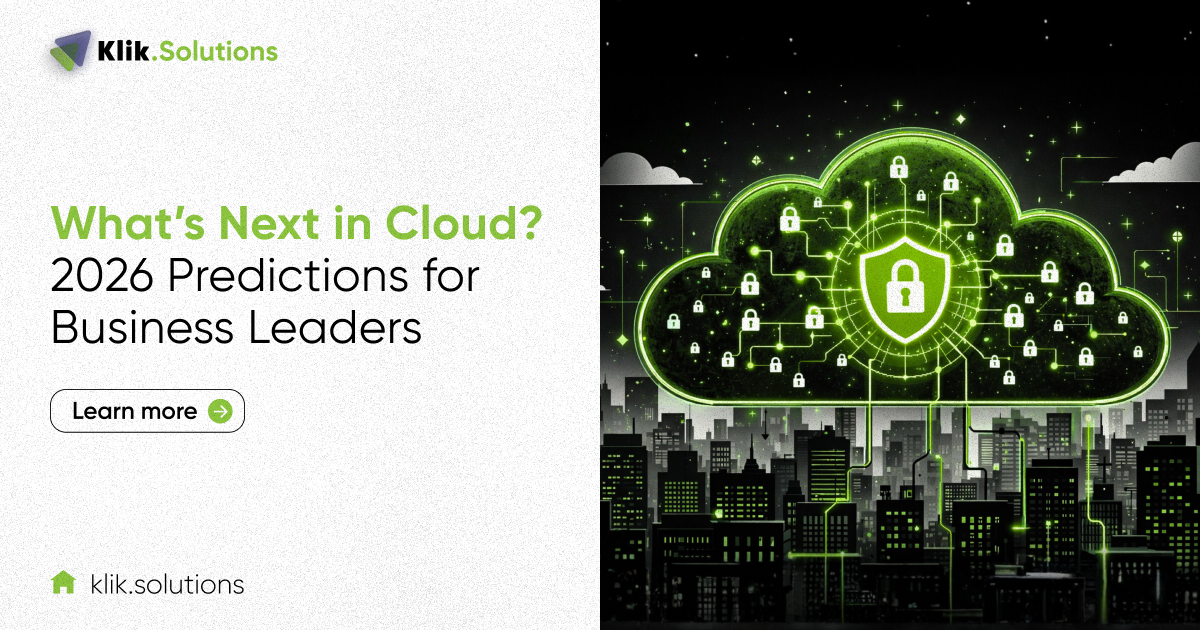
The cloud revolution is over. The Cloud Era has just begun. For the past decade, the focus of business technology has been on migration: moving systems, data, and applications off-premises and into the scalable, flexible environments provided by hyperscalers such as AWS, Azure, and Google Cloud.
By 2026, the global shift is largely complete. The conversation is no longer about if you should use the cloud, but how you use it. This shift in focus marks a pivotal moment where businesses will no longer tolerate accidental cloud spending, haphazard security, and disconnected architectures.
Business leaders are now demanding measurable ROI, strategic alignment, and cost discipline from their cloud investments. They require systems designed for the future, a future dominated by Artificial Intelligence (AI) and characterized by increasingly stringent compliance and security requirements.
This article outlines the key cloud trends and predictions for 2026 that every CEO, CFO, and CTO must integrate into their strategic planning now. At Klik Solutions, we help businesses move from cloud complexity to intentional, business-aligned cloud strategy, ensuring they are running smart, not just running fast.
Why 2026 Will Be a Turning Point for Cloud Strategy
We are exiting the phase of cloud adoption and entering the phase of cloud maturity. These critical business pressures are driving the transition:
Cloud Maturity vs. Cloud Chaos
Early cloud adoption often resulted in fragmented infrastructure, redundant services, and unclear ownership. This is what we call “Cloud Chaos.” As the technology matures, the market is demanding order, standardization, and optimized architecture. The focus shifts from feature accumulation to resource rationalization.
Executives Demand ROI, Not Just Uptime
Uptime is a prerequisite, not a metric of success. CFOs and CEOs are now scrutinizing cloud bills and demanding straightforward evidence that cloud spend directly contributes to revenue growth, speed-to-market, or operational efficiency. They now view unallocated or poorly utilized cloud resources as financial waste.
AI Workloads Changing Infrastructure Needs
The rise of generative AI and machine learning is introducing new demands on cloud infrastructure that standard virtual machines cannot efficiently meet. Planning for 2026 means re-architecting systems to manage intense data pipelines, specialized processors, and massive, real-time data storage.
Prediction #1. Cloud Cost Discipline Becomes Non-Negotiable
Cloud cost optimization (or FinOps) is shifting from a recommendation to a mandatory operational framework.
· End of “Set It and Forget It” Cloud Spending
The practice of provisioning resources and leaving them running indefinitely, regardless of actual usage, will be aggressively curtailed. Automated shutdown schedules, capacity rightsizing, and continuous monitoring of utilization will become standard operational procedures.
· FinOps Adoption Becomes Standard
The principle of FinOps—bringing financial accountability to the variable spend model of the cloud—will move from a niche concern to a core business process, involving finance, technology, and business leadership. This requires cultural change, not just technology.
· Continuous Optimization Over Annual Reviews
Annual or quarterly cost reviews are ineffective in dynamic cloud environments. In 2026, optimization will be continuous, driven by real-time dashboards and automated governance rules that enforce budgets and utilization policies immediately.
Klik’s approach to cloud cost visibility: We implement FinOps frameworks, deploying specialized tools that provide transparent, real-time attribution, showing exactly which business unit or project is driving specific cloud costs, enabling actionable budgeting.

Prediction #2. AI Workloads Will Redefine Cloud Architecture
The need to run powerful AI models will become a major architectural driver, demanding specialized hardware.
· GPUs, AI-Optimized Instances, and Data Pipelines
IT leaders must plan for the specialized compute requirements of AI. This includes investing in specific Virtual Machine (VM) types equipped with Graphics Processing Units (GPUs) or dedicated AI chips for training and inference workloads. The entire data pipeline, from ingestion and storage to processing, must be optimized for speed and scale to feed the models efficiently.
· Cloud Readiness for AI Models and Inference
Businesses will focus on optimizing for inference (using an already-trained model), which is often more cost-sensitive than training the model itself. Serverless computing and specialized edge devices will see increased use for delivering AI results to customers in real-time.
Why Data Quality Matters More than Computation
The axiom “garbage in, garbage out” is exponentially true for AI. Leaders will prioritize data quality, governance, and organization over brute-force compute power, recognizing that clean, well-structured data is the most critical asset for effective AI deployment.
Prediction #3. Security Shifts to Identity-First Cloud Models
The traditional network perimeter has dissolved in the cloud. Identity is the new control plane.
· Identity and Access Management as the New Perimeter
Cloud security in 2026 will center on Identity and Access Management (IAM). This means tightly controlling and monitoring who (or what machine account) accesses which resources, from where, and under what conditions.
· Zero Trust Becomes the Baseline
The principle of Zero Trust, never automatically trusting any user or device, even inside the network, will become the mandatory baseline for cloud security strategy. This requires pervasive use of Multi-Factor Authentication (MFA) and micro-segmentation.
· Cloud Misconfigurations Remain Top Risk
Despite advancements, human error in configuring cloud environments (e.g., leaving storage buckets publicly accessible, overly permissive IAM roles) remains the leading cause of data breaches. Automated configuration auditing tools will become essential to mitigate this risk.

Prediction #4. Multi-Cloud Gets Smarter
Multi-cloud—using services from multiple providers (e.g., AWS, Azure, Google)—will evolve from accidental sprawl to intentional, strategic architecture.
· Purpose-Driven Multi-Cloud, Not “Cloud Sprawl”
Instead of using multiple clouds randomly, 2026 will see businesses adopting specific providers based on best-of-breed services (e.g., using Google for AI/data analytics and AWS for core infrastructure). The goal is optimization and mitigation of vendor lock-in, not simply diversification.
· Operational Complexity vs. Resilience Trade-offs
Business leaders must weigh the increased complexity and specialized skills required to manage multiple clouds against the genuine need for resilience and vendor negotiation leverage. Unless a true business or technical need exists, the focus will be on simplifying and consolidating.
Prediction #5. Compliance Moves into the Cloud Stack
Compliance will no longer be a post-deployment checklist; it will be a foundational component of cloud architecture.
· Built-in Compliance Controls and Continuous Audit Readiness
Cloud providers are building more compliance tools directly into their services. Leaders must utilize these native tools for automated logging, access reviews, and data retention enforcement. The goal is continuous audit readiness, where evidence is generated automatically, not manually gathered.
· Industry-Specific Cloud Governance
For regulated industries (finance, healthcare), customized cloud governance frameworks that automatically enforce HIPAA or PCI-DSS requirements will become common.
Prediction #6. Automation Becomes the Backbone of Cloud Ops
Manual cloud management cannot keep pace with dynamic workloads. Automation is the key to efficiency, security, and cost control.
· Infrastructure as Code (IaC)
Tools like Terraform and CloudFormation will be mandatory for defining and provisioning cloud resources. This ensures consistency, repeatability, and prevents configuration drift, which is a major compliance risk.
· Automated Scaling, Patching, and Security Enforcement
Routine maintenance—like scaling resources based on demand, patching operating systems, and enforcing security policies—will be almost entirely automated, reducing human error and freeing up engineers for strategic work.
Prediction #7. Cloud Strategy Aligns Directly with Business Outcomes
Cloud technology must serve the overarching goals of the business, not just the IT department.
· Cloud as a Business Enabler, Not Just IT Infrastructure
Impact on business KPIs will drive cloud decisions—reducing time-to-market for new products, enhancing customer experience (CX), or enabling competitive data analysis.
· Cloud Decisions Driven by KPIs, Not Convenience
Discussions about cloud architecture will move from technical specifications (like latency) to direct business value (like transaction speed or customer churn reduction).
How Business Leaders Should Prepare Before 2026
The time for preparation is now. Strategic planning completed before January ensures immediate momentum and competitive advantage.
- Cloud Audits and Architecture Reviews: Conduct a comprehensive review of your current cloud environment to identify unused resources, security gaps, and architectural inefficiencies.
- Cost Governance Frameworks: Establish a formal FinOps framework with clear ownership and real-time reporting capabilities. Investigate Reserved Instances (RIs) or Savings Plans immediately.
- Security and Identity Modernization: Enforce MFA across all accounts and begin the phased rollout of Zero Trust principles centered around IAM.
- AI Readiness Assessments: Inventory your data assets and determine the architectural changes (GPU requirements, data pipeline upgrades) needed to support your key AI initiatives for 2026.
How Klik Helps Leaders Navigate the Next Cloud Era
Klik Solutions specializes in providing the clarity, strategy, and managed oversight required to master the complexity of the modern cloud environment.
- Cloud Strategy + FinOps + Security: We provide end-to-end expertise, ensuring your architecture is cost-optimized, secure-by-design, and aligned with your business growth objectives.
- Architecture Optimization and Consolidation: We rationalize fragmented cloud environments, implementing IaC principles and consolidating redundant services to drive efficiency and reduce complexity.
- Ongoing Monitoring and Managed Cloud Services: Our managed services team provides 24/7/365 monitoring and automated enforcement, ensuring continuous compliance, peak performance, and cost control without taxing your internal resources.
- Translating Technical Decisions into Business Impact: We speak the language of the boardroom, ensuring every technical recommendation is justified by clear financial and operational benefits.
Plan your 2026 cloud strategy: book a cloud readiness assessment and cost review with Klik.
FAQs
What will change most about cloud computing in 2026?
The most significant change will be the shift from migration/adoption to optimization and specialization. Cloud usage will become heavily influenced by the specialized, high-demand workloads of Artificial Intelligence, forcing organizations to focus intensely on cost control (FinOps) and architectural upgrades (GPUs, optimized data pipelines).
How can businesses control cloud costs more effectively?
Effective cost control requires implementing a FinOps culture, which means:
1) Establishing real-time visibility and cost attribution (knowing who spends what).
2) Continuous, automated optimization (rightsizing resources and automated shutdowns).
3) Utilizing commitment contracts like Reserved Instances (RIs) or Savings Plans for predictable workloads.
Is multi-cloud still a good strategy in 2026?
Yes, but it must be strategic. Accidental multi-cloud sprawl, driven by decentralized IT, is a source of complexity and cost. Strategic multi-cloud, driven by a specific purpose (e.g., using a provider’s unique AI tools or achieving necessary geo-resilience), remains a valid strategy for mitigating vendor lock-in and leveraging best-of-breed services.
How does Klik support long-term cloud optimization?
Klik supports long-term optimization through a continuous cycle of managed services: we establish a FinOps framework, use automation (IaC) to maintain optimized architecture, provide 24/7 monitoring to prevent configuration drift and cost overruns, and conduct regular strategic reviews to align the cloud environment with evolving business goals.