How to Get Tech Support That Feels Like a Real Partner, Not a Bot
 Published on February 17, 2026
Updated on February 26, 2026
 5 mins to read
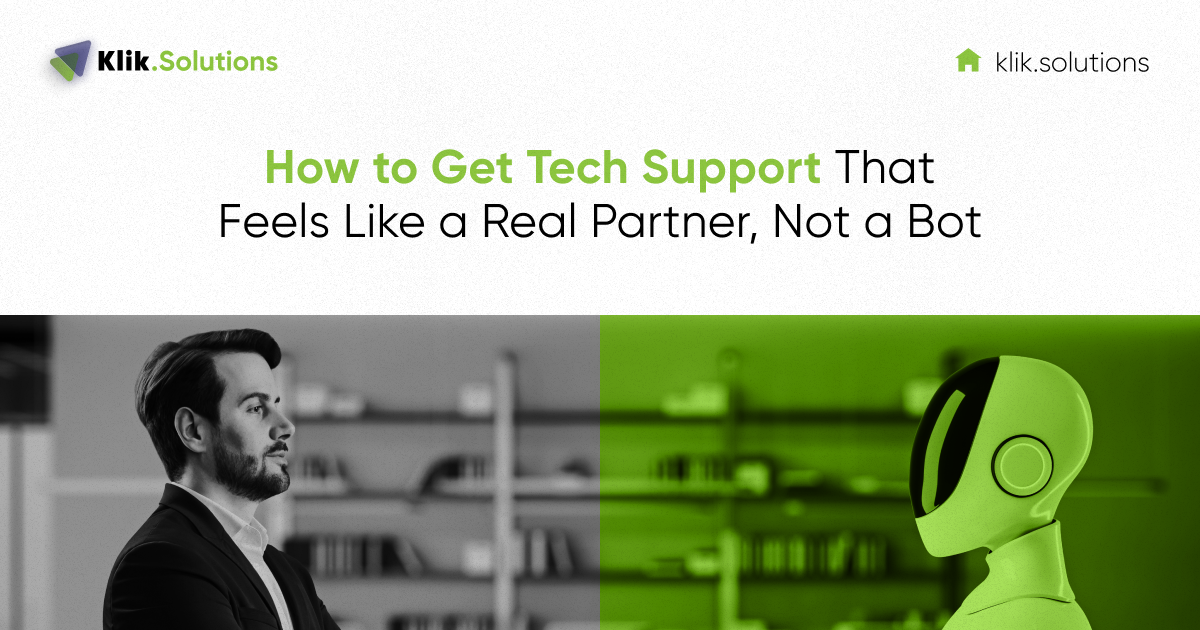
In the modern business landscape, technology is the nervous system of your organization. It handles your communications, secures your most sensitive data, and powers your productivity. Yet, for many business owners, the relationship with their Managed Service Provider (MSP) feels less like a partnership and more like a long-distance relationship with a ghost.
A common friction point in the business world is the disconnect between basic technical maintenance and true strategic growth. It’s the space between having a vendor who simply fixes broken laptops and having a dedicated partner who actively scales your vision. While many providers focus on the “now” of troubleshooting, we focus on the “next” of your business evolution.
You know the feeling. An issue arises, you send an email into a void, and hours later you receive a generic response from a “bot” or a technician who doesn’t know your name, your business goals, or why this specific downtime is costing you thousands of dollars per minute.
If you’ve ever felt like your IT is a “necessary evil” rather than a strategic asset, this guide is for you. Here is how to identify tech support that feels human, proactive, and truly collaborative.
1. The Shift: From “Reactive Fixing” to “Predictive Partnership”
The traditional IT model is “Break-Fix.” Something breaks. You call. They fix it, and you get an invoice. This model is fundamentally flawed because it incentivizes your IT provider to wait for you to have a bad day. The more problems you have, the more they work. A real partner operates on the opposite frequency: Predictive Maintenance.
Instead of reacting to failures, a partner prevents them. By utilizing proactive monitoring, a true collaborator identifies a failing hard drive or a security vulnerability at 2:00 AM on a Sunday and resolves it before your team even logs in on Monday morning.
Ask yourself: Does your IT provider call you to tell you about a problem they’ve already solved? If not, you’re dealing with a vendor, not a partner.
2. Security That Isn’t a Hurdle
In the age of AI and rapidly evolving cyber threats, security is often the biggest “logjam” in a business. Many IT companies “solve” security by locking everything down so tightly that your team can’t actually work. They add layers of friction that lead to employees finding “workarounds” that actually make the firm less secure.
Alex Binder, the founder of Killian Law Group, knows this tension well. Handling sensitive legal data in a world of AI-driven phishing and ransomware isn’t just a technical challenge; it’s a matter of professional survival.
“If we didn’t have a proper cybersecurity team behind us, we wouldn’t be comfortable doing what we’re doing now,” Alex shares. For Killian Law Group, partnering with Klik Solutions changed the math. By implementing identity-based, seamless authentication, the team can access what they need instantly, while the “proper cybersecurity team” works behind the scenes. This gives the firm the confidence to innovate with AI and cloud platforms without the constant fear of a data breach. When security feels like a “green light” instead of a “stop sign,” you’ve found a partner.

3. The “20-Minute Rule”: Efficiency as a Metric
One of the clearest indicators of a partner-level relationship is how they value your time. In a bot-led environment, a simple task—resetting a permission, accessing a folder, or syncing a device—can take 20 minutes of back-and-forth communication. When your tech stack evolves into a strategic partner, that friction fades. At Killian Law Group, tasks that previously took 20 minutes are now completed in seconds.
How does a partner achieve this?
- Automated Data Flow: They ensure your tools actually talk to each other. Your CRM should flow into your billing, which should flow into your project management. No manual transfers. No copy-paste errors.
- Standardized Environments: A partner ensures every workstation is optimized identically, so there are no “unique” glitches that stall production.
- Actionable Intelligence: They provide clear dashboards that highlight trends. You shouldn’t have to hunt for data; your systems should translate it for you.
4. Financial Clarity: No More “Surprise Invoices”
A partner provides Zero-Waste Licensing and Self-Optimizing Cloud environments.
- The Partner Approach: They provide full visibility into your usage. If you have 50 licenses for a software but only 40 employees are using it, a partner alerts you to cut the waste.
- Cloud Scalability: Your cloud environment should scale in real-time, expanding for major project launches and contracting during slower periods. You should only pay for the “compute” you actually use.
A bot-based support system doesn’t care about your bottom line. A partner knows that if they save you money on “shelfware,” you’ll have more budget to invest in the strategic growth they are helping you build.

5. Scaling Without the Growing Pains
Are you planning to open a new office? Launching a new product line? Adding ten new remote employees next month?
To a bot-led support team, this is a “Change Request” that will take weeks of tickets and hardware orders. To a strategic partner, this is a business-ready scalability event.
Because a partner understands your business roadmap, they’ve already built the “plug and play” infrastructure. They don’t have to rebuild from scratch every time you grow; they simply turn the dial up. This allows you to focus on the “What” (your business expansion) while they handle the “How” (the underlying architecture).
6. The Human Element: Empathy in a Technical World
Technology can be frustrating. When a system goes down, it isn’t just a “ticket”; it’s a person who can’t do their job, a client who isn’t being served, and a business owner feeling the weight of overhead.
A partner-level tech team understands the emotional stakes of downtime. They don’t speak in error codes; they speak in solutions. They provide:
- Direct Access: You know your lead engineers by name.
- Contextual Knowledge: They know that your “Monday Morning Scramble” is your most important time of the week, and they prioritize accordingly.
- Strategic Guidance: They don’t just fix what’s broken; they ask, “How can we make this better so it never breaks again?”
A tech burden—legacy systems, endless updates, and “good enough” support—drains your time, patience, and focus. A true partner gives that time back. They act as the “quiet engine” behind your momentum, empowering you to innovate rather than just survive.
The right tech partner isn’t a luxury; it’s your competitive edge. When your team can complete tasks in seconds instead of minutes, and your data is protected by a team you actually trust, you are finally free to serve your clients at a higher level. Klik Solutions doesn’t just fix problems. We bridge the gap between your business goals and the technology needed to reach them.
Want to schedule a quick audit to see exactly where your current tech stack is holding you back? Reach out today, and let’s turn your IT into your quiet engine of growth.
FAQ
How do I know if I’m currently “bot-supported”?
Look at your last three tickets. Was the response immediate but generic? Did you have to explain who you were or what your business does? If the technician lacked “business context,” you are likely in a high-volume, low-value support model.
Is proactive IT more expensive than reactive IT?
Initially, the monthly seat price for proactive support may be higher than a “pay-as-you-go” model. However, when you factor in the cost of downtime, the risk of data breaches, and the wasted salary hours of employees waiting for tech fixes, proactive partnership is almost always significantly cheaper in the long run.
Can a partner help me with AI implementation?
Absolutely. A true partner doesn’t just manage your current stack; they help you vet new technologies. They ensure that when you adopt AI, you are doing so on a secure foundation that protects your client data—just like we did for Killian Law Group.
What is the first step in moving to a partnership model?
It starts with a “Business Technology Alignment.” This isn’t just an inventory of your computers; it’s a deep dive into your business goals for the next 3 to 5 years. Once we know where you want to go, we can build the engine to get you there.
BLOG
The latest articles
-

-
-
We See THIS Before a Security Issue, and Most Teams Miss It!
-
The Simple Way to Stay Compliant in 2026 Without Losing Your Mind
-
How to Get Tech Support That Feels Like a Real Partner, Not a Bot
-
Why “More Tools” Didn’t Improve Their Data — And What Actually Did
-
We Often See This Pattern Before a Cybersecurity Incident — Here’s Why It Happens