
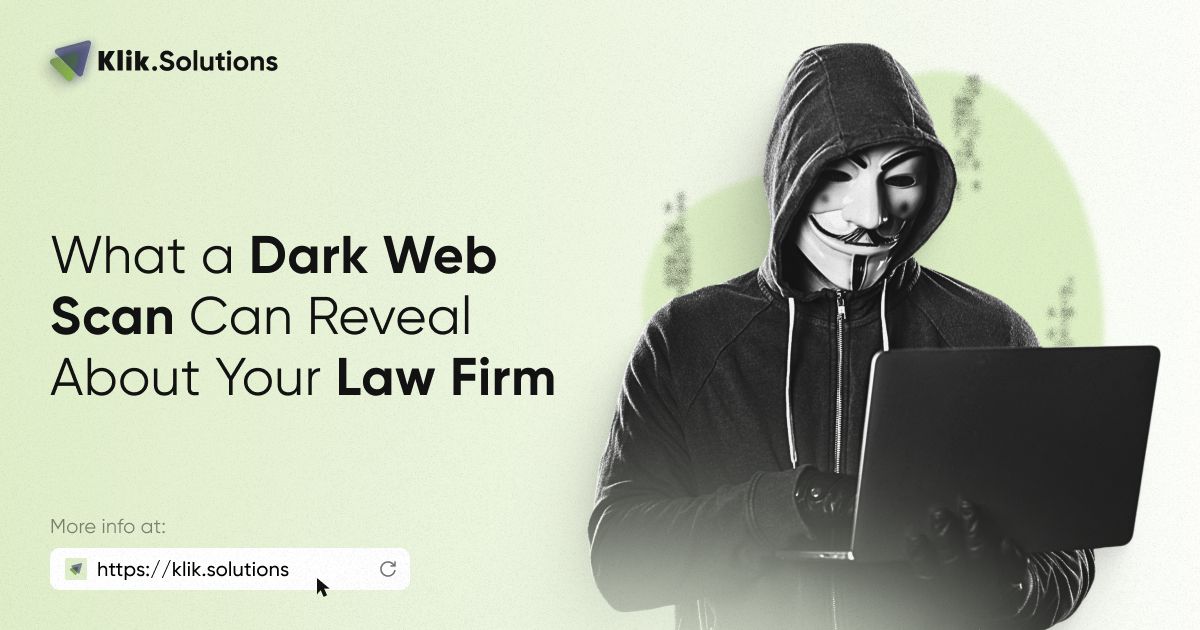
What a Dark Web Scan Can Reveal About Your Law Firm
 Published on June 5, 2026
Updated on June 5, 2026
 6 mins to read
The email arrived on a Tuesday morning. A managing partner opened her inbox and found a message from a long-term client, who had received a security alert from a vendor and wanted to know if any firm information had been exposed.
The partner immediately called the firm’s IT provider, and the first response was reassuring. There were no signs of a breach, no ransomware, no suspicious activity, and no missing files. Everything appeared normal.
The conversation could have ended there. Instead, the firm decided to run a Dark Web Scan, and within hours, they discovered multiple employee email addresses tied to compromised credentials that had been circulating online for months.
The firm’s systems were not breached. At least not yet. However, someone, somewhere, had information that could help them try. That realization changed the conversation entirely.
Cybersecurity often focuses on what happens inside your network. Firewalls, antivirus software, endpoint protection, access controls, and monitoring all play important roles. Yet some of the most significant risks to a law firm exist beyond the walls of its technology environment.
A Dark Web Scan shines a light into those blind spots, and what it reveals may surprise you.
The Problem Most Law Firms Never See
Many law firms invest heavily in protecting their data. They implement security tools, train employees, and establish policies designed to reduce risk.
Those efforts matter, but there is a challenge that many firms overlook.
Not every cybersecurity risk begins inside your organization. Information can be exposed through third-party breaches, compromised websites, reused passwords, former employee accounts, or vendors that experience their own security incidents.
In many cases, the affected organization has no idea the exposure occurred.
The information simply appears elsewhere. Months may pass before anyone notices.
That creates a dangerous gap between exposure and discovery. The longer that gap remains open, the more opportunities attackers have to exploit it.
The most concerning cybersecurity risks are not always the ones triggering alarms today. Sometimes they are the ones quietly waiting for an opportunity tomorrow.
What Does a Dark Web Scan Really Do?
The term “Dark Web” often creates images of mysterious hackers operating in hidden corners of the internet. The reality is both less dramatic and more important.
The Dark Web comprises online spaces not indexed by traditional search engines. This often requires specialized tools to access. While there are legitimate uses for these networks, they are also common marketplaces for stolen information.
Cybersecurity professionals monitor these areas because they frequently contain data linked to security incidents.
A professional Dark Web Scan searches for indicators that information connected to your organization may have been exposed. That can include:
- Employee email addresses.
- Compromised usernames and passwords.
- Leaked credentials from third-party breaches.
- Corporate domains appearing in exposed datasets.
- Information that could be used for phishing or account takeover attempts.
The purpose is not to create fear. The purpose is to gain visibility. You cannot respond to a risk you do not know exists.

What a Dark Web Scan Can Reveal About Your Law Firm
Employee Credentials Already in Circulation
One of the most common discoveries involves employee credentials. An attorney may use the same password for multiple accounts. A staff member may have registered a business email address on a third-party platform years ago.
That platform experiences a breach. The credentials are stolen. The employee never knows. The law firm never knows. Yet the information may continue circulating among cybercriminals long after the original incident.
This does not necessarily mean your network has been compromised. It does mean attackers may already possess information that helps them target your organization more effectively.
Hidden Risks to Client Trust
Trust is one of the most valuable assets a law firm possesses. Clients share sensitive information because they believe it will remain protected.
A Dark Web Scan can reveal potential exposures that threaten that trust before they become larger problems. Sometimes the discovery is relatively minor. Sometimes it reveals patterns that deserve immediate attention. Either way, visibility allows leadership to make informed decisions rather than reactive ones.
That distinction matters. When firms learn about cybersecurity issues from attackers, regulators, or clients, the conversation is rarely comfortable.
When firms discover risks themselves, they maintain control over the response.
Exposure Through Vendors and Third Parties
Law firms depend on a growing ecosystem of technology providers. This includes things like:
- Practice management platforms.
- Document storage systems.
- File-sharing solutions.
- Cloud applications.
- Communication tools.
Every new platform expands capabilities. It can also expand risk. Many credential exposures originate outside the law firm’s direct control.
A Dark Web Scan can help identify indicators connected to third-party incidents that may affect your organization. That visibility becomes increasingly important as legal technology environments grow more interconnected.
Signs That Attackers Already Have a Head Start
Cybersecurity is often compared to a race. The problem is that many organizations do not realize the race has started. If exposed credentials, email addresses, or organizational information already exist within criminal marketplaces, attackers may have spent months gathering intelligence before making their first move.
That doesn’t mean an attack is inevitable. It does mean the playing field may not be as level as it appears. Understanding what information is already available helps organizations close gaps before they become entry points.

Why Law Firms Continue to Attract Cybercriminal Attention
Many legal professionals assume attackers focus primarily on large enterprises.
Some do, but size is rarely the only factor. Value matters.
Law firms often possess information that is extremely valuable to the wrong people, information such as:
- Client records.
- Financial information.
- Contract negotiations.
- Litigation documents.
- Real estate transactions.
- Merger and acquisition activity.
- Personally identifiable information.
- Confidential communications.
Cybercriminals understand the value of that data. They also understand that many law firms operate with lean internal technology teams and competing business priorities.That combination makes the legal industry an attractive target.
The issue is not whether a firm is important enough to attract attention. The issue is whether the information it holds is valuable enough. In most cases, the answer is yes.
What Happens After a Dark Web Scan?
One of the biggest misconceptions about Dark Web monitoring is that finding something is the end goal. It isn’t. The scan is simply the starting point.
Once potential exposures are identified, organizations can take meaningful action. That may include resetting compromised credentials, strengthening password policies, implementing multi-factor authentication, reviewing access controls, increasing monitoring, or providing additional security awareness training.
The right response depends on what is discovered. What matters most is having the opportunity to respond before a bad actor forces the issue.
Cybersecurity improvements are always more effective when they are proactive rather than reactive.

The Real Value Isn’t Finding Something
This may sound counterintuitive. A successful Dark Web Scan is not measured by the number of exposures it uncovers. Sometimes the most reassuring result is finding very little.
The true value comes from gaining visibility. Business leaders make better decisions when they have access to accurate information.
The same principle applies to cybersecurity. A hidden operational problem does not become less dangerous because nobody can see it. It simply continues to grow unnoticed.
The same is true for security risks. A compromised credential sitting in an underground marketplace may not create an immediate crisis. But it introduces uncertainty. It creates opportunity. It increases risk.
Organizations that actively monitor for and look for these exposures are not operating out of fear. They are operating from awareness. The awareness that allows them to reduce uncertainty and strengthen resilience over time.
The Call You Never Want to Receive
The managing partner from our opening story was fortunate. The firm discovered the exposure before a client reported a breach. Before a ransomware event.
Before a regulatory issue. Before a public relations crisis. Nothing catastrophic happened, and that was exactly the point.
The goal of cybersecurity is not simply to recover from disasters. Rather, the goal is to identify risks early enough that many disasters never occur at all.
A Dark Web Scan cannot eliminate every threat facing a law firm. No single security tool can. What it can do is reveal information that might otherwise remain hidden, and in cybersecurity, visibility is often the difference between responding to a risk and being surprised by one.
What you don’t know can be difficult to protect.
A Dark Web Scan can help uncover exposed credentials, compromised email addresses, and other indicators that may put your law firm at risk. If you want a clearer picture of your firm’s exposure, Klik Solutions can run a complimentary Dark Web Scan so you can gain insight into risks that may already be outside your network. Reach out for more information.
FREQUENTLY ASKED QUESTIONS
What is a Dark Web Scan for a law firm?
A Dark Web Scan searches hidden areas of the internet for exposed information connected to a law firm, including employee credentials, email addresses, and other data that could increase cybersecurity risk.
What can a Dark Web Scan reveal about a law firm’s cybersecurity posture?
A Dark Web Scan can identify compromised credentials, leaked information from third-party breaches, exposed corporate domains, and other indicators that may signal elevated risk.
Why are law firms attractive targets for cybercriminals?
Law firms often store confidential client information, financial records, legal documents, and other sensitive data that can be valuable to cybercriminals.
How often should a law firm perform a Dark Web Scan?
Law firms should consider regular Dark Web monitoring or periodic scans as part of a proactive cybersecurity strategy to identify exposures before they lead to larger security incidents.
Can a Dark Web Scan help protect client trust and reputation?
Yes. By identifying potential exposures early, law firms can take corrective action before risks impact clients, damage reputation, or disrupt business operations.